Thrift stores can save you a lot of money.
They can also make it very easy to buy things you did not need just because the price looked low.
That is the real difference between a useful thrift-store haul and a pile of clutter: knowing what actually holds value secondhand, what can be inspected quickly, and what is better bought new.
This guide focuses on the categories that are usually worth checking first — and the ones that often look like deals but are not.
⚠️ Prices below are general U.S. thrift-store examples. Actual pricing, quality, and store policies vary a lot by location.
What Makes Something Worth Buying Secondhand
The best thrift-store finds usually have a few things in common:
- they are durable enough to survive previous use
- they can be inspected easily in the store
- the secondhand discount is meaningfully lower than retail
- they still solve a real need at home
That last part matters most.
A low price is not the same thing as value.
Quick Comparison
| Category | Usually worth buying? | Why |
|---|---|---|
| Solid wood furniture | Yes | Durable, high replacement cost new |
| Cast iron cookware | Yes | Long lifespan, easy to restore |
| Picture frames | Yes | Very overpriced new |
| Books | Yes | Low risk, strong value |
| Glass / ceramic kitchenware | Yes | Easy to inspect, often cheap |
| Lamps | Usually | Good value if tested |
| Mattresses / pillows | No | Hygiene and wear concerns |
| Car seats / helmets | No | Safety risk, hidden damage possible |
| Untested electronics | Usually no | High failure risk |
| Worn shoes | Usually no | Support and fit issues |
What Is Usually Worth Buying at Thrift Stores
Solid Wood Furniture
This is one of the best secondhand categories because real wood furniture is expensive new and often holds up well over time.
A used wood dresser, shelf, or side table can cost a small fraction of retail.
What to look for:
- real wood, not swollen particle board
- sturdy legs and frame
- drawers that open and close properly
- dovetail joints if possible
What worked best in practice: heavy, simple furniture with good bones usually gave the best value, even if the finish was not perfect.
Cast Iron Cookware
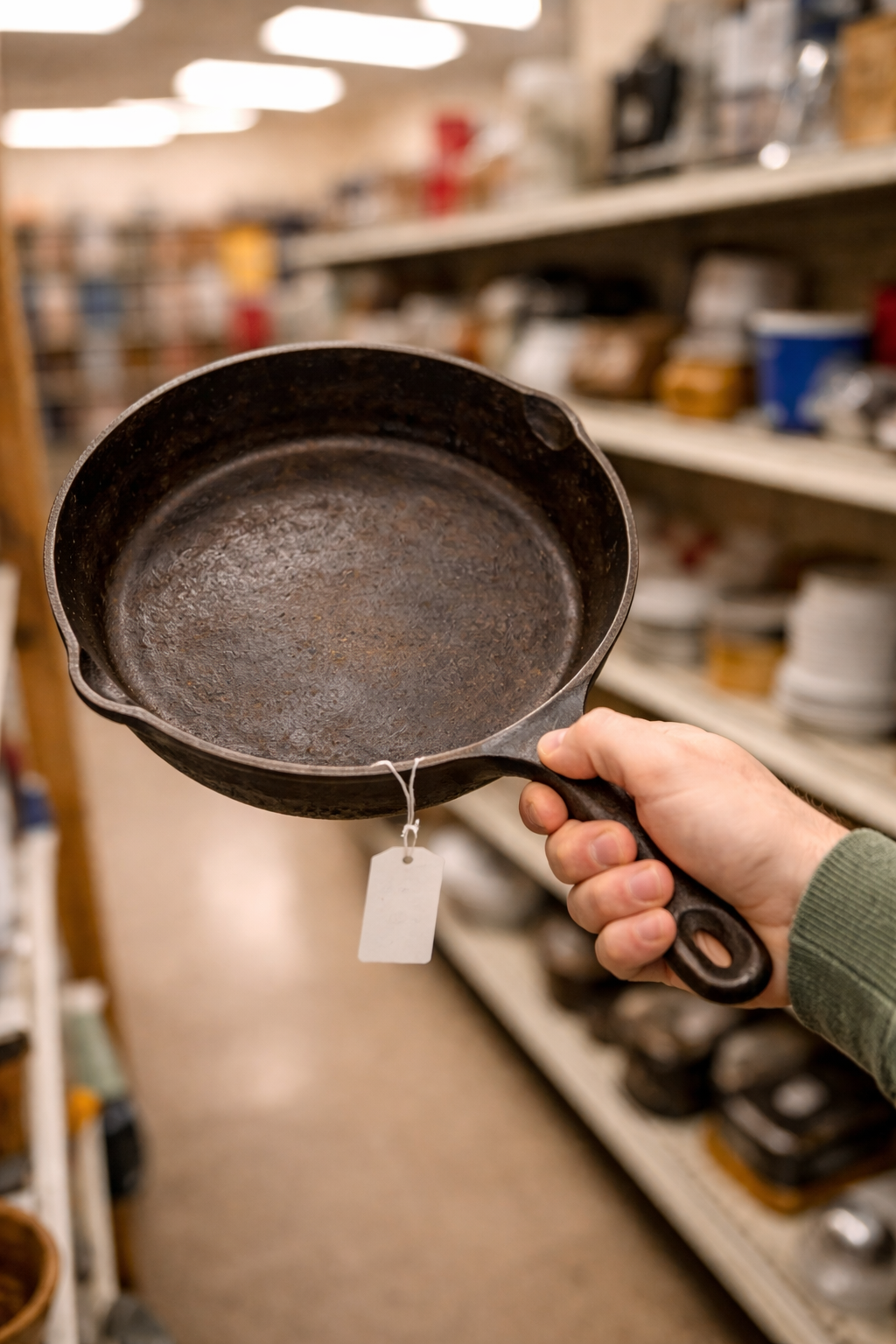
Cast iron is one of the safest secondhand kitchen buys because it is so durable.
Even rusty pieces can often be restored if the pan is structurally sound.
Check for:
- cracks
- warping
- major pitting
Surface rust is usually manageable. Structural damage is not.
Picture Frames
Frames are one of the easiest thrift-store wins.
They are often:
- cheap
- easy to inspect
- easy to repaint or reuse
The print inside usually does not matter. The frame is the value.
Books
Books are low-risk, easy to inspect, and often very cheap secondhand.
This is especially useful for:
- kids’ books
- cookbooks
- novels you only plan to read once
- decorative hardcovers for shelves
The value is even better if you are replacing casual new-book purchases with used ones.
Glass and Ceramic Kitchenware
Mixing bowls, mugs, baking dishes, and basic serving pieces are often good thrift finds if they are intact.
Check carefully for:
- cracks
- chips
- hairline damage
- cloudy or damaged surfaces
If the item is in good shape, there is often very little downside.
Lamps
Lamps can be excellent thrift-store buys because the structure often lasts much longer than the style.
A lamp base can still be useful even if:
- the shade is ugly
- the color is wrong
- it needs a quick clean
The important part is testing it first if possible and checking the cord for visible damage.
What Is Usually Better to Skip
Mattresses and Pillows
These are usually not worth the hygiene risk.
Wear, allergens, pests, mold, and hidden condition problems make them poor secondhand buys for most people.
Car Seats and Helmets
These are not good thrift purchases because safety damage is not always visible.
A car seat can be expired or previously damaged. A helmet can look fine and still be compromised.
These are categories where new is the safer choice.
Electronics You Cannot Test
A cheap appliance is not a deal if it does not work.
Untested electronics are risky because:
- many thrift stores have limited return policies
- cords and internal parts may be damaged
- small appliances can fail quickly
If you can test it and it works, fine. If not, the risk goes up quickly.
Shoes With Visible Wear
Some secondhand shoes are worth buying, especially if they were barely worn.
But shoes with:
- worn soles
- broken structure
- flattened insoles
- stretched shape
are usually not good value.
The issue is not only durability. It is comfort and foot support.
Anything With a Strong Smell
This includes:
- smoke smell
- mildew
- pet odor
- heavy chemical smell
Some odors wash out. Some do not.
If something smells bad in the store, there is a good chance the problem will be harder to remove than it seems.
A Simple Thrift Store Checklist
Before buying, ask:
- Do I actually need this?
- Can I inspect it well right now?
- Would I still want it if it cost twice as much?
- Do I know where it will go at home?
If the answer to most of those is no, it is probably not a good thrift buy.
What Worked Best in Practice
The strongest thrift-store purchases were usually:
- practical, not aspirational
- easy to inspect
- clearly cheaper than buying new
- durable enough to handle previous use
Furniture, books, frames, and kitchenware tended to be the most reliable categories.
What Didn’t Work as Well
A few patterns usually led to regret:
- buying something only because it was cheap
- buying “project pieces” without a real plan
- ignoring smell, damage, or missing parts
- assuming every thrift item is automatically a deal
Secondhand clutter is still clutter.
How to Get Better Deals
A few habits help:
- shop with a loose list
- bring measurements for furniture spaces
- check retail prices quickly if unsure
- inspect items slowly instead of rushing
- look beyond the front display
It also helps to know what your store tends to price aggressively and what it tends to undervalue.
Keep Going
If you want the thrift-store mindset to support the rest of your home spending, these pair well with it:
And for the broader home side of frugal living, the Frugal Home category archive keeps the whole cluster connected.
FAQ
What are the best things to buy at a thrift store?
Solid wood furniture, cast iron cookware, picture frames, books, glass kitchenware, and lamps are usually among the best-value categories.
What should you avoid buying secondhand?
Mattresses, pillows, car seats, helmets, strongly scented items, and electronics you cannot test are usually the highest-risk categories.
How do you know if thrift-store furniture is good quality?
Check the material, weight, construction, joints, drawer movement, and general sturdiness. Real wood pieces usually offer the best long-term value.
Are thrift-store clothes worth it?
They can be, especially for basics, jackets, denim, and kids’ clothes. The key is checking seams, stains, elastic, and overall wear.
How do I avoid bringing home clutter?
Go in with a list, ask whether the item solves a real need, and avoid buying things just because the price feels hard to pass up.
Conclusion
Thrift stores save the most money when you treat them as a tool, not an excuse to buy random cheap things.
The best secondhand finds are durable, useful, easy to inspect, and meaningfully cheaper than buying new.
That is usually the real rule: buy value, not just low prices.